translate

Showing posts with label A)Aircraft. Show all posts

Tuesday, May 21, 2013

CAF Centex B-25, the "yellow Rose" still flying after 70 years.

The "Yellow Rose" Centex's B-25 has a rich history.

Visit Centex Wing's Historic Hanger and see our B-25.
The B-25 is one of the best-known and most recognizable aircraft of World War II. 
The B-25 made famous by "Doolittle's 1942 Raid" on Japan.
The actual flight deck of the USS Hornet on April 18, 1942 showing the chevron arrangement needed by the B-25s to gain the extra length required for a successful takeoff.

Great Cockpit GoPro video 4 - minutes.


The B-25 proved to be a rugged and versatile fighting machine.  It was used as a horizontal bomber; for low level attack and ground support.  The Navy used it as a patrol bomber against enemy shipping and submarines. It was fitted a variety of armaments.  Some versions had fourteen forward-firing machine guns and the “G” and “H” models featured forward firing 75mm cannon!  


Unfortunately, of the approximately 10,000 planes built by North American, only about 30 are still airworthy.  
Women B-25 Engineering Test Pilots.
Dorothy Dodd Eppstein, Hellen Skjersaa Hansen, Doris Burmester Nathan and Elizabeth Chadwick Dressler, walk in front of a B-25 plane, as they were Air Force engineering test pilots for the B-25 during World War II.

One of these is the “Yellow Rose” operated by the Yellow Rose Squadron of the CAF, based in San Marcos, Texas. 
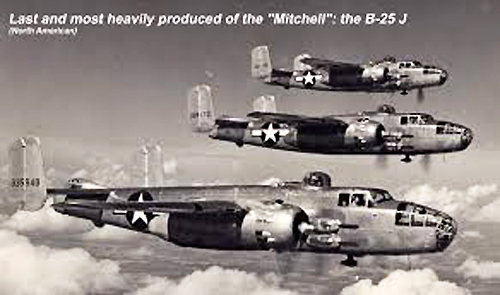
Rose, also known as B-25 B-25J-5-NC-Serial Number 43-27868, is one of the finest examples of the B-25 flying today.  She was built and delivered to the Army Air Corps in 1944.  The B-25J was the largest production run of this aircraft.  
It was armed with thirteen machine guns and fitted with the top secret Norden Bomb Sight to guide its bombs to the target.  Rose is a flying example of this model, complete to its bombsight, moveable turret and machine guns. 


The "Yellow Rose", the christened name of the vintage B-25J Mitchell WWII bomber, is once again touring the American skies. The bomber is completely restored to its wartime capabilities and is operated by the Central Texas Wing of the Commemorative Air Force (CAF). It is one of the flying museum pieces belonging to the organization's "Ghost Squadron" aircraft collection. After four years, the aircraft was lovingly restored to WWII condition by members of the Central Texas Wing and donated to the CAF in 1981. 
Keeping a B-25 built in 1943 in flying condition is quite an accomplishment in of itself.

Literally thousands of man hours were donated over the four year period by the members of the Yellow Rose Squadron in order to bring the Rose back into full operational readiness. The restoration project met numerous problems including the lack of parts and, of course, lack of funds. With the help of dedicated aviation enthusiasts throughout the state of Texas and the skill of volunteer craftsmen, the plane was again ready to fly. The airplane now visits an average of 25 cities and towns across the United States each year as a patriotic and education exhibit dedicated to those who gave their all for world freedom during WWII. 
The Rose is a flying museum. You can go through the Smithsonian Air and Space Museum in Washington D.C. and see an awe inspiring display of aircraft. However, the majority of people never get the opportunity to do that. 
The Central Texas Wing flies its museum piece to the people, and that's quite a feat considering the airplane is over 70 years old. If seeing this warbird isn't enough, people can lay their hand on the rivets that keep her together. You can crawl through the Rose, touch it, smell the hydraulic fluid, and get greasy from those big radial engines. 
The Yellow Rose flying over the USS Lexington, the same class aircraft carrier as the USS Hornet.
Since the two 1,700 horsepower engines burn approximately $350 worth of fuel per hour, costs run high for the Central Texas Wing. Staffed entirely by volunteers, financing is accomplished mainly through donations, tours of the aircraft, and the sale of memorabilia. These monies help to offset the high operational cost. As a non-profit, tax exempt organization, the CAF must rely on the communities that the Rose visits as the legacy of this historic aircraft endures. "We are very careful with every penny," said Jack Hart, a Central Texas Wing member. "Everyone on the crew is a volunteer, and each member pays his or her own expenses. However, we never turn down outside donations." The North American B-25J Mitchell "Yellow Rose" is one of the over 11,000 B-25s built during WWII. There are only twenty-seven restored and flying in the United States at this time. Colonel Kelly Klaus, the Executive Officer of the Central Texas Wing estimates that there may be 35 B-25s in any condition, worldwide.

B-25 Technical Data


Crew

6


Propulsion

2 Radial Engines
Engine Model
Wright R-2600-92 Cyclone
Engine Power (each)
1268 kW
1700 hp

Speed
443 km/h
239 kts
  275 mph
Service Ceiling
7.376 m
24.200 ft
Range
2.172 km
1.173 NM
1.350 mi.

Empty Weight
8.836 kg
19.480 lbs
max. Takeoff Weight
15.876 kg
35.000 lbs

Wing Span
20,60 m
67,6 ft
Wing Area
56,7 m²
610 ft²
Length
16,13 m
52,9 ft
Height
4,98 m
16,3 ft

First Flight
01/1939 (NA-40) 19.08.1940 (B-25)
Production Status
out of production
Total Production
Appox. 10,000

NATO Code
Bank
Data for (Version)
North American B-25J Mitchell
Variants
B-25, B-25A, B-25B / Mitchell Mk I, B-25C / Mitchell Mk II. ZB-25C, B-25D, ZB-25D, ZXB-25E, B-25G, B-25H, B-25J / Mitchell Mk III, CB-25J, VB-25J, AT-24A / TB-25D, AT-24B / TB-25G,


For More in formation on The Central Texas Wing of The Commemorative Air Force 

Monday, May 20, 2013

CAF Centex Wing Museum has B-25, the same type of plane that saw action in every theater of WWII

The B-25 Mitchell, a rugged and versatile fighting machine, served in every theater of World War II.
The "Yellow Rose", CAF - Centex Wing's Still flying B-25J.

Nothing else sounds like a B-25. The beautiful, soul-jarring roar of its mighty radial engines evokes memories of an era that has become one of the defining moments in America’s history. 
America enters the war totally unprepared.
On December 7, 1941, America was attacked and her citizens’ right to enjoy peace and freedom was challenged. At the time, we were at best a fourth or fifth-rate air power. Yet, as we have on every occasion before and since, the American people responded. Within a few short years, the mightiest air armada ever seen was assembled and deployed around the world.
Approximately 11,000 B-25 were produced at rates of ten a day.
World War II was the first time that control of the battlefield required control of the air. America’s ability to prosecute all future wars grew out of the lessons we learned about airpower during that era and how to effectively employ it. 
B-25 proved to be very rugged and was deployed at rustic forward airfields like isolated Pacific islands.
The B-25 Mitchell, named after Gen. Billy Mitchell, was first flown in 1939 and served in every theater of the war. They operated from unimproved strips on Pacific islands and from runways in North Africa covered with blowing sand.  The Mitchell penetrated fortress Europe from bases in Italy and England and was launched from the deck of the aircraft carrier Hornet during the famed Doolittle raid on Tokyo. The B-25 is one of the best-known and most recognizable aircraft of World War II.
A B-25 takes off from the USS Hornet on April 1942 to attack Japan, only four months after Pearl Harbor.
It proved to be a rugged and versatile fighting machine. It was used as a horizontal bomber; for low level attack and ground support. 

The Navy used it as a patrol bomber against enemy shipping and submarines. It was fitted a variety of armaments. Some versions had fourteen forward-firing machine guns and the “G” and “H” models featured forward firing 75mm cannon!
A B-25H Without its distinctive clear front, was used for close ground support.
A B-25H had powerful nose armament.
Unfortunately, of the approximately 11,000 planes built by North American, only about 30 are still airworthy. One of these is the “Yellow Rose” operated by the Yellow Rose Squadron of the CAF, based in San Marcos, Texas.
The North American B-25 Mitchell was an American twin-engined medium bomber manufactured by North American Aviation. It was used by many Allied air forces, in every theater of World War II, as well as many other air forces after the war ended, and saw service across four decades.

The B-25 was named in honor of General Billy Mitchell, a pioneer of U.S. military aviation. By the end of its production, nearly 10,000 B-25s in numerous models had been built. These included a few limited variations, such as the United States Navy's and Marine Corps' PBJ-1 patrol bomber and the United States Army Air Forces' F-10 photo reconnaissance aircraft.

The B-25 was a descendant of the earlier XB-21 (North American-39) project of the mid-1930s. Experience gained in developing that aircraft was eventually used by North American in designing the B-25 (called the NA-40 by the company). One NA-40 was built, with several modifications later being done to test a number of potential improvements. These improvements included Wright R-2600 radial engines, which would become standard on the later B-25.

In 1939, the modified and improved NA-40B was submitted to the United States Army Air Corps for evaluation. This aircraft was originally intended to be an attack bomber for export to the United Kingdom and France, both of which had a pressing requirement for such aircraft in the early stages of World War II. However, those countries changed their minds, opting instead for the also-new Douglas DB-7 (later to be used by the U.S. as the A-20 Havoc). Despite this loss of sales, the NA-40B re-entered the spotlight when the Army Air Corps evaluated it for use as a medium bomber. Unfortunately, the NA-40B was destroyed in a crash on 11 April 1939. Nonetheless, the type was ordered into production, along with the Army's other new medium bomber, the Martin B-26 Marauder.


Early production


B-25H production at the Kansas City, facility.

An improvement of the NA-40B, dubbed the NA-62, was the basis for the first actual B-25. Due to the pressing need for medium bombers by the Army, no experimental or service-test versions were built. Any necessary modifications were made during production runs, or to existing aircraft at field modification centers around the world.

A significant change in the early days of B-25 production was a redesign of the wing. In the first nine aircraft, a constant-dihedral wing was used, in which the wing had a consistent, straight, slight upward angle from the fuselage to the wing tip. This design caused stability problems, and as a result, the dihedral angle was nullified on the outboard wing sections, giving the B-25 its slightly gull wing configuration. Less noticeable changes during this period included an increase in the size of the tail fins and a decrease in their inward cant.

A total of 6,608 B-25s were built at North American's Fairfax Airport plant in Kansas City, Kansas.

A descendant of the B-25 was the North American XB-28, meant to be a high-altitude version of the B-25. Despite this premise, the actual aircraft bore little resemblance to the Mitchell. It had much more in common with the Martin B-26 Marauder.


Far East


The majority of B-25s in American service were used in the Pacific. It fought on Papua New Guinea, in Burma and in the island hopping campaign in the central Pacific. It was in the Pacific that the aircraft’s potential as a ground attack aircraft was discovered and developed. The jungle environment reduced the usefulness of standard level bombing, and made low level attack the best tactic. The ever-increasing amount of forward firing guns was a response to this operational environment, making the B-25 a formidable strafing aircraft.

In Burma the B-25 was often used to attack Japanese communication links, especially bridges in central Burma. It was also used to help supply the besieged troops at Imphal in 1944.

In the Pacific the B-25 proved itself to be a very capable anti-shipping weapon, sinking many of the ships being used to reinforce the Japanese position. Later in the Pacific war the distance between islands limited the usefulness of the B-25, although it was used against Guam and Tinian. It was also used against Japanese-occupied islands that had been bypassed by the main campaign, as happened in the Marshall Islands.
Middle East and Italy
American B-25 pilots plane for the Battle of El Alamein.
The first B-25s arrived in Egypt just in time to take part in the Battle of El Alamein. From there the aircraft took part in the rest of the campaign in North Africa, the invasion of Sicily and the advance up Italy. In Italy the B-25 was used in the ground attack role, concentrating on attacks against road and rail links in Italy, Austria and the Balkans. The B-25 had a longer range than the Douglas A-20 Havoc and Douglas A-26 Invaders, allowing it to reach further into occupied Europe. The five bombardment groups that used the B-25 in the desert and Italy were the only U.S. units to use the B-25 in Europe.
Europe
B-25 Mitchell bombers of 321st Bomber Group, US 447th Bomber Squadron flying past Mount Vesuvius, Italy during its eruption of 18-23 Mar 1944.
The U.S. Eighth Air Force, based in Britain, concentrated on long-range raids over Germany and occupied Europe. Although it did have a small number units equipped with twin-engined aircraft, the B-25 was not amongst them. However, the RAF received nearly 900 Mitchells, using them to replace Douglas Bostons, Lockheed Venturas and Vickers Wellington bombers. The Mitchell entered active RAF service on 22 January 1943. At first it was used to bomb strategic targets in occupied Europe. After the D-Day invasion the RAF used its Mitchells to support the armies in Europe, moving several squadrons to forward airbases in France and Belgium.


For More in formation on The Central Texas Wing of The Commemorative Air Force 

Sunday, May 19, 2013

CAF Centex B-25, "Yellow Rose" and its restoration timeline

The History of the CAF Centex Wing's B-25 "Yellow Rose."
The North American B-25J Mitchell "Yellow Rose" is one of the over 11,000 B-25s built during WWII. There are only twenty-seven restored and flying in the United States at this time. Colonel Kelly Klaus, the Executive Officer of the Central Texas Wing estimates that there may be 35 B-25s in any condition, worldwide.
Over 11,000 B-25s built during WWII.
Our B-25J the "Yellow Rose" is one of perhaps 35 remaining worldwide.
Photo taken at the Thunder Over Michigan Show at Ypsilanti, 2007.

Here the "Yellow Rose's" special story.

1943: 
The Commemorative Air Force B-25 Yellow Rose was built in 1943 as B-25J-5-NC, serial number 43-27868.
Women were a large part of the work force at the assembly plant.
April 26,1943
The Yellow Rose was delivered, over one year before the end of World War II.
May 1944:
The aircraft was assigned to the 334th Bombardment (Medium) Group (Third Air Force) and later, to the 331st AAF Base Unit (Combat Crew Replacement Training), 3rd AF, Greenville Army Air Field (AAF), South Carolina. There were deployments to Myrtle Beach AAF, SC and Columbia AAF, SC during this period.

February 1945:
The Rose was assigned to the 128th AAF Base Unit (Continental Air Force), Greenville AAF, SC. 
December 1945: The Rose was assigned to the 112th AAF Base Unit (ConAF), Hartford AAF, CT.
January 1946:
The aircraft was assigned to the 112th AAF Base Unit (ConAF), Westover AFB, Massachusetts. 
February 1946: The Rose was placed in storage at the 4168th AAF Base Unit (Air Technical Service Command) at South Plains AAF, Texas.
July 1947:
The aircraft was transferred to another storage location at the 4141st AAF Base Unit (Air Material Command) at Pyote AAF, Texas.

July 1949:
The bomber was removed from storage and assigned to the 3750th Technical Training Wing (Air Training Command) as a ground instructional airframe at Shepard AFB, Texas. It remained there for almost seven years without flying, which explains the low airframe time.

April 1956:
The aircraft was flown to the Birmingham Modification Center where Hayes Aircraft Company converted it to a TB 25N and returned it to flying status.
June 1956:
The plane was assigned to the 3640th Pilot Training Wing (ATC) at Laredo AFB, Texas and that assignment included a deployment to Offutt AFB, Nebraska.
September 1958:
The aircraft was put back into storage at the Arizona Aircraft Storage Branch (Air Material Command) at Davis-Monthan AFB, Arizona.
December 11, 1959:
The Rose was sold to Fogle Aircraft Co., Tucson, AZ for $1,395. Later, in February 1960, Dothan Aviation Corp bought the aircraft for for $2,500.
March 1960:
The registration number N9077Z was issued for the aircraft.
January 1962:
The aircraft was modified for agricultural spraying and dusting.
October 1975:
The bomber was sold to John Stokes of San Marcos, TX.
September 1977:
John Stokes was approached by future CAF partners and he sold to Charles Skipper of Boerne, TX, Charles Becker, of San Antonio, TX and Jack Jones, of San Antonio, TX.
July 1979:
The aircraft was sold to the Confederate AF in Harlingen, TX.
July 1991:
The registration was changed to N25YR and the title transferred to the American Airpower Heritage Flying Museum, Midland. TX.

January 2002:
The Confederate Air Force changed its name to the Commemorative Air Force.


For more information about the restoration work accomplished by the CAF Centex Wing Please visit Blog Post.
For More in formation on The Central Texas Wing of The Commemorative Air Force 

CAF Centex Air Wing - "Yellow Rose" participates in largest gathering of B-25 in 40 years!

CAF Centex Air Wing's - B-25, the "Yellow Rose" participates in the 68th Doolittle Raiders reunion, the largest gathering of the remaining B-25 in 40 years!

17 B-25 Medium Range bombers preparing for take off from Wright Patterson AFB, Ohio, and flying in formation over the National Museum of the U.S. Air Force to pay tribute to the Doolittle Raiders in a ceremony to honor their fellow airman that could not be in attendance.
Jimmy Doolittle's B-25 Medium Range bombers takes off from the USS Hornet April 1942 as part of "Doolittle Raiders" historic bombing of Japan.

On April 22, 2010, 17 B-25 bombers attended the reunion, to honor the 4 surviving original airmen on the 1942 raid.

Here are four great videos of the event and flight.


April 22, 2010The following report of the 68th Doolittle Raiders Reunion, held last weekend in Dayton, Ohio, comes from Ken Kula, EAA 404432 of Manchester, New Hampshire, who drove 13.5-hours to attend. - Editor
CAF Centex's own "Yellow Rose".

The Doolittle Tokyo Raiders Association Reunion was held Friday through Saturday, April 16-18, at the U.S. Air Force Museum abeam Wright Patterson AFB, Dayton, Ohio. There are eight surviving crew members of the 80 who flew on the mission and four attended the reunion, including 88-year-old MSgt. David Thatcher (engineer/gunner - aircraft #7); 90-year-old Lt. Col. Robert Hite (co-pilot of aircraft #16 - the last one off the USS Hornet); 92-year-old Maj. Thomas Griffin (navigator and mission planner - aircraft #9); and 94-year-old Lt. Col. Richard Cole (co-pilot of aircraft #1 - Jimmy Doolittle’s plane, see photo below). 
Photo of Air Crew No. 1

Crew No. 1 in front of B-25 #40-2344 on the deck of the USS Hornet, 18 April 1942. From left to right: (front row) Lt. Col. Doolittle, pilot; Lt. Richard E. Cole, copilot; (back row) Lt. Henry A. Potter, navigator; SSgt. Fred A. Braemer, bombardier; SSgt. Paul J. Leonard, flight engineer/gunner. (U.S. Air Force photo)
CAF Centex scale model of USS Hornet during take-off.
CAF Centex's own highly detailed scale model at its Museum in San Marcos, Texas

The distinctive chevron arrangement needed for extra distance just prior to take off.
Actual 1942 photo of the USS Hornet showing the distinctive chevron arrangement.

All four men had numerous public autograph sessions, with hundreds of people in a line snaking through the museum, waiting for every two-hour session. We attended a 45-minute media conference to ask questions and hear their stories on Friday afternoon.
The "Yellow Rose", CAF Centex Wing's B-25

A few items of note: one member said it was common to for B-25 pilots to be deaf in their left ear because their engines were notoriously loud. Lt. Col. Hite, co-pilot on #16, said he had no doubt he’d make it off the Hornet OK because the other 15 had already done it. Co-pilot in #1, Lt. Col. Cole, said he wasn’t afraid being first to takeoff because he was alongside the best pilot in the group, then-Maj. Doolittle!

The other half of the weekend’s festivities centered around the gathering of 17 B-25s, the largest gathering of the North American-built bombers since the making of the film Catch-22 (1970) more than four decades ago. Staging out of Grimes Field in nearby Urbana, Ohio, the planes thundered onto the museum grounds Saturday morning, landing on a private runway behind it. They were presented on static display Saturday for the public, and departed Sunday around noon to perform a 17-ship fly past to open a commemorative ceremony for the Doolittle Raiders at the Museum.


The gathering included one of each version: B-25A, B-25D, B-25H, PBJ (Navy/Marine version), plus 13 B-25Js. The fly past on Sunday was spread out in three columns filling the sky for some 30 seconds. The rumble of 34 Wright Cyclone engines overhead was chilling and thrilling at the same time. I’d hate to have been underneath the bombers as they delivered their payloads in wartime, but then I marveled at the resourcefulness and dedication it took to put these aircraft all overhead at once for the reunion.

We were honored to be able to watch and listen to the men, who volunteered for their mission. At the time, I don’t think they knew of the raid’s importance. Only historians have brought out the two main impacts of the 16-ship raid - that America’s morale soared, for it was a much-needed early victory in the war, and Japan was immediately put on the defensive because they now needed to protect their homeland, slowing down their offensive plans that, up until that point, had resulted in a string of victories.


For More in formation on The Central Texas Wing of The Commemorative Air Force